Showing posts with label Maya Mountains. Show all posts

Sunday, January 22, 2012

Sunsets over the Mountain Pine Ridge

I love sunsets. I always have. As a boy, my father would take me to the Pacific shore to watch the sun set over the sea and he would use that as a visual metaphor for, well, for whatever he wanted to talk to me about. Getting things done on time. Passage of time. The world. New horizons. Everything under the sun.

This blog entry shows what we accomplished between two sunsets, Thursday, January 5 and Friday, January 6. I have embedded snapshots I took and short, unedited video-clips by Rhea. Just a little text so you can go through as fast or slow as you wish. As always, comments are appreciated, either here, by email or on Facebook.

After our busy day at Hidden Valley Inn, we went home to Blancaneaux. The kind people there love wildlife and have helped me in my attempts to learn more about the mammals that live in the forest around their wonderful lodge. If you have been a guest there, you know what a magical place it is. If not, their website give a sense of the wonder: http://www.coppolaresorts.com/blancaneaux

I use the word "home"' as Blancaneux feels homey. The people who work there greet us like cousins they have not seen since the last reunion. Those reunions come too far apart!

We went up the stairs to our usual room and looked East:

From 2012-01-06

and then West:

From 2012-01-06

Yes, we had used every bit of daylight before we arrived. Fortunately we knew the steps to the huge horseshoe-shaped hot tub down by the stream bank and so could soak away the muscle aches from a long day of hiking.

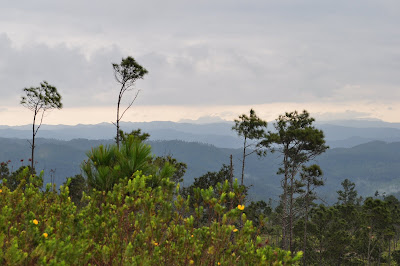
After breakfast, we set out with the legendary Roni deep into the Mountain Pine Ridge. We paused periodically to admire the view:
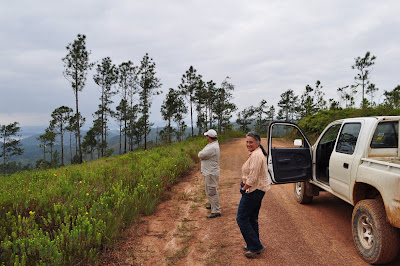
From 2012-01-06


From 2012-01-06

Yes, that is the same Cockscomb we watched the sun set near from Maya Beach just last year:
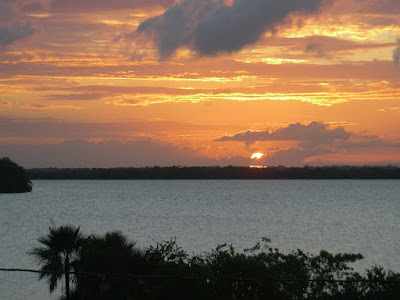
From 2012-01-02

(Oops, Victoria Peak is not visible in this snapshot, but trust me, it was just out of frame to the right.)

We continued down the road, descending

From 2012-01-06

into the broadleaf forest of the upper Macal River valley:

From 2012-01-06


From 2012-01-06


until we were forced to park and walk

From 2012-01-06

to the bank of the river:

From 2012-01-06

Where Rhea took videos:

From 2012-01-06


From 2012-01-06

From the river bank, we ascended back up into the pine forest on the ridges.


Much of the tropical pine forest in the Mountain Pine Ridge area of the Maya Mountains was damaged by an outbreak of pine bark beetles in 2000-2001 (Report by U.S. National Public Radio, with 5' audio option, from August 3, 2001, is archived here: http://www.npr.org/programs/morning/features/2001/aug/beetles/beetles.html ; regional overview here: http://www.fao.org/docrep/007/y5507e/y5507e05.htm ).

This video clip by Rhea gives a sense of the roads through the pine forest:


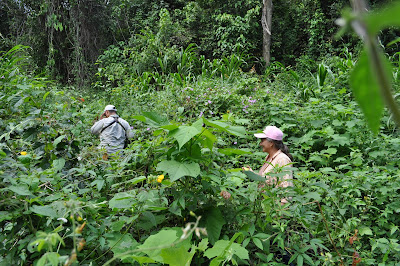
With the deforestation caused by the beetles, much of the canopy was lost, letting sunlight to the forest floor and allowing a proliferation of herbaceous vegetation. This sometimes had to be cleared to allow passage:

and sometimes we used the powerful vehicle to push through:

We were of course navigating by GPS to wildlife camera trap locations on a grid. Since I described that in the previous blog entry, I won't bore you with that again.

I do want to talk about logging. Harvest of timber from tropical forests gets a bit of bad press from some parts of the conservation community. I'd like to share my perspective. I grew up in Oregon, where the wood products industry dominated the economy in the 20th century. The logging methods commonly used up there back then, clear cutting, devastated forests and the watersheds in them. The Northern Spotted Owl received the most international press coverage, but I was personally more impacted by the damage to salmon spawning beds. My father was a commercial salmon troller (sales pitch for his book on the subject: http://www.amazon.com/Fishing-Beyond-Buoys-Salmon-Trolling/dp/1878175041). The fishing industry was destroyed by the logging industry. So, I saw the environmental damage from poor forestry practices along with the economic benefits of the wood products industry to rural communities. Can forestry ever be practiced responsibly and sustainably?

I would like to share a few snapshots of what I believe is an example of responsible forest harvest in Belize. I know the name of the company, but am not sharing it here as I neglected to ask explicit permission to blog. If you are the owner, feel free to comment or to ask me to remove these photos.

Pine tree cut down in a selective logging operation:
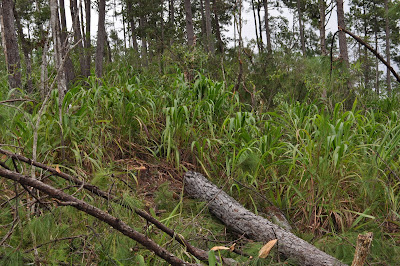
From 2012-01-06


Log loading point:

From 2012-01-06

Note the small "footprint" relative to the scale of the operation!
Logger's forest camp:

From 2012-01-06

Again, this operation directly damaged very little land area relative to the amount of wood harvested. From an ecological standpoint, it reminded me of a large wind storm.  This selective harvesting had no resemblance to the clear-cut logging on steep slopes I saw routinely practiced in Oregon in the 1970s and 1980s.

From this place, we headed up higher and higher through beautiful terrain:

From 2012-01-06

to the highest places in the Mountain Pine Ridge:

From 2012-01-06

where only a few small trees grew:

From 2012-01-06

but many other interesting plants did:
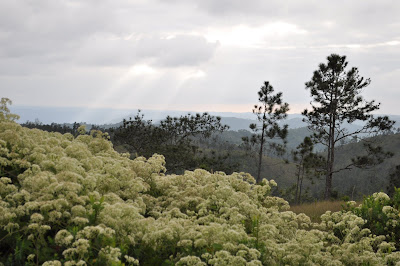
From 2012-01-06

Hypercium:

From 2012-01-06


From 2012-01-06

and even Lycopodium, an ancient plant that in the tropics is found only at high elevations:

From 2012-01-06


Rhea of course took videos.

From 2012-01-06


From 2012-01-06

Here are a few:
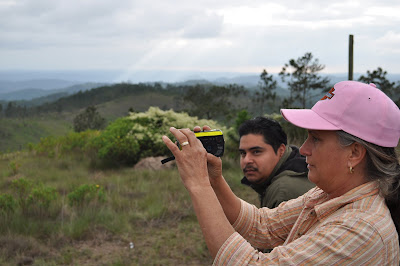
Looking down from the pine forest we drove up from--

Looking out over the bald hills of Belize--

Watching the evening fog roll in over the Bald Hills of Belize--

Walking through the grasses on top of a bald hill--


I am saving the best for last. In this video clip, Rhea covers the landscape ecology of the area in just one minute. Amazing! If you watch only one of her videos, let it be this one:


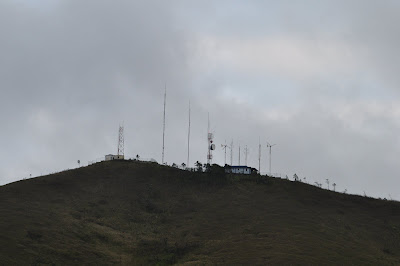
We get up to Baldy Beacon itself
From 2012-01-06

as the sun is going down:

From 2012-01-06

It was a truly amazing day.
Sunday, January 15, 2012

Hidden Valley Inn

You know the experience of wanting something unattainable. We hope you also know the joy of getting there. This blog entry describes such an experience: a visit to Hidden Valley Inn.

Like most regular visitors to the Cayo district of Belize, we knew of HVI as the exclusive resort off the road to the Thousand Foot Falls high in the Maya Mountains of Belize. Here is the description of the highest waterfall in Mesoamerica on the official tourism website of Belize: http://www.travelbelize.org/index.php?option=com_content&task=view&id=104&Itemid=325&Ytemid=407

Here is a snapshot of Dr. & Dr. Terdal (Erik's parents) at the 1000' Falls back in 2009:
From MPR 2009

Hidden Valley Inn itself (http://www.hiddenvalleyinn.com/) has 12 rooms on 7200 acres (2900 Ha). Think about that for a minute or two. Most of the land is high on the Mountain Pine Ridge at about 2000 feet (600 meters) above sea level. The north of the property features an escarpment dropping down to tropical broadleaf forest along Barton Creek. You know the 1000' falls? Bad name: it is more like 1600' (500 meters). Yes, Erik has wanted to explore this area since his first visit in 1999 when he bought a copy of Means, D. Bruce. 1997. Natural history of Mountain Pine Ridge, Belize. Bull Run Overseas, Ltd., Benque Viejo del Carmen, Belize. 94 pages. 


We knew HVI had the best raptors in Belize, but what about mammals? Erik has wanted to find out for over a decade. Erik had introduced himself to the managers previously, and was waiting permission to set camera traps. In late 2011, he got it! Much thanks to our friends at Blancaneaux Lodge (http://www.coppolaresorts.com/blancaneaux) for coordinating. 


The morning of Wednesday, 3 January, we awoke at Clarissa Falls (http://www.clarissafalls.com/) where we feel like family, having been regulars since 1998 and often staying for a month at a time.

Erik breakfasted on his favorite, huevos rancheros with corn tortillas:
and did work for his University (http://www.nsuok.edu/) using the strong WiFi signal Clarissa Falls has.

Erik made a little time for photography, his hobby:
Erik uploaded both of these to his Facebook page and immediately was hated by his coworkers.

We checked out, paid and drove the Suzuki Jimny

From Garden Centre Belize


away, after leaving behind at Clarissa Falls the Areca palm (Dypsis lutescens) Erik won months earlier in a Facebook contest sponsored by the Garden Centre (http://www.facebook.com/pages/The-Garden-Center-Belize/157287564315902?v=info).

We bought out the store in Santa Elena of Duracell D batteries , then continued east on the Western Highway to the Georgeville Road. Headed up that. Fun! If you have driven up that way, you can imagine how delightful it was to drive a Suzuki up that collection of boulders called a "road" in jest.

We appreciated the excuse to stop at Moonracer (http://moonracerfarm.com/default.aspx). The official reason to stop was to ask them to telephone HVI to say we were running late, but really we wanted to smell the bread baking in their new oven: http://moonracerfarmbelize.blogspot.com/2011/10/cooking-with-wood.html Moonracer has a great chef; if we didn't already have dinner reservations at HVI we would have tried to finagle a seat at the table....

We made our way up the road, past the Mountain Pine Ridge Forest Reserve checkpoint. Staff there are always friendly. Continued up, turning left onto Cooma Cairn road at the signs for 1000' Falls and Hidden Valley Inn. Past the Bull Run fire lookout tower to the entrance sign for Hidden Valley Inn. Proceeded to the circle drive by the main house. Parked and went in. Front desk staff came out to greet us warmly. Big smiles all around!

We were given warm tea and offered massages. Rhea enjoyed a hand massage as her hands were hurting from tightly gripping the Suzuki steering wheel up the Georgeville road. Erik was eager to get to work and so refused to sit down.

Massage over, we set out in the Suzuki, following HVI staff in their vehicle. First stop was Butterfly Falls. We parked and walked part way down the path to the ecotone where pine forest blends into broadleaf forest. Ecologists have loved edge habitat ever since Aldo Leopold established its importance for wildlife back in the 1920s. We placed our first camera trap:

From 2012-01-06

and tested it to make sure it worked:

From 2012-01-06

We placed another camera trap in the pine forest:

From 2012-01-06

and tested it:

From 2012-01-06


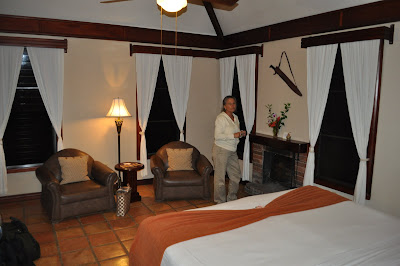
We were running out of daylight and so headed back to the HVI main house. From there we were directed to our cottage. Rhea examined the bed:

From 2012-01-06

and then the fireplace:

From 2012-01-06

as it was cold!.
Good thing there were matches behind the note on the mantle, plus wood in the fireplace and more on the porch.

From Rhea Belize 2012


We showered and changed clothes, then went to the main house. Drinks in the bar and chatting with other guests. The couple we talked to most were from Scotland and had saved money for years to come to Belize.

Dinner was great. Erik had a snapper fish filet that was superb. The chef (who came out to introduce herself) let the fish stand out as a flavour rather than masking it, as too many chefs do. Rhea had the cowfoot soup. Call her a traditionalist. Sorry, no photos: we were too famished to take the time for pictures. Portions were large, so Erik took his pecan pie and ice cream desert back to the room as a bed-time snack. One more note: tap water in the cottages is safe to drink and especially tasty. We love our water and appreciate the taste difference in water from granite vs. limestone. Terroir and all that.

With the fire crackling, we slept very, very well.

In the morning (Thursday, January 5, 2012) we rose and walked through the lovely gardens to the Main House for breakfast. Served buffet-style, we had yogurt, fruit and coffee. That is one of the HVI trademarks: they grow and roast coffee right there. Doesn't get any fresher. While we enjoyed the fruit pieces on our plates, a staff member set out fresh fruit (i.e., what we were eating) on a platform feeder for the birds just outside the dining room. The birds were clearly expecting him and they flocked. Erik's favorite was the green jay (Cyanocorax yncas).

After breakfast, we packed up our luggage and loaded the trusty little Suzuki. Disappointed to have missed the legendary Butterfly Falls despite being so close the previous afternoon, we headed there first. Be patient for several amateur photographs....

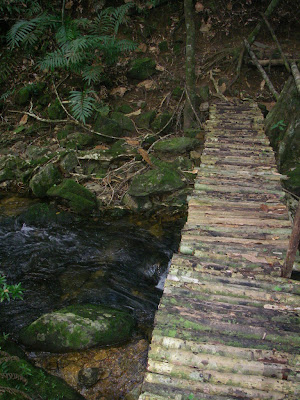
Bridge on path to waterfall; another visitor to HVI took snapshots of a jaguar on this very bridge recently.
From Rhea Belize 2012
Scene on the trail to Butterfly falls:
From 2012-01-06
And at last the falls themselves:
From 2012-01-06
Which required the mandatory posed snapshots:
From 2012-01-06
And of the two of us:
From 2012-01-06
And finally with our friend, the legendary Roni:
From 2012-01-06

We hope you can forgive a digression. On the hike back, Erik found a palm he could not identify. Here are a few snapshots. If you have a guess as to its identity, please comment. In brief, it is a slim--trunked feather (pinnate) palm of the undercanopy. Not found in the pine forest or the broadleaf forest--just this ecotone between them. Other palms in the area are Schippia concolor, Attelea cohune and Chameadorea spp. Not one of those. Best guess is the Maya palm ( Gaussia maya). Help, please!
From 2012-01-06

From 2012-01-06

From 2012-01-06

From 2012-01-06
And for the flower lovers following this blog, here is an epiphytic orchid:
From 2012-01-06
From Butterfly Falls, we hiked back to our vehicles and sought a third camera trap site for our grid. The first place we checked was the overlook to Tiger Falls:
From 2012-01-06
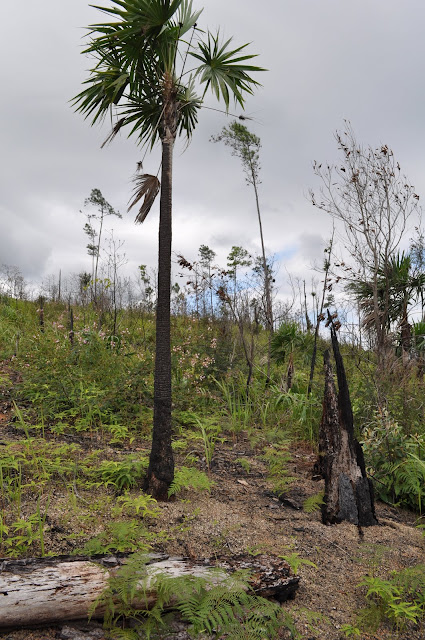
in an area that experienced forest fires last May:
From 2012-01-06
from which the vegetation is recovering:
From 2012-01-06
From 2012-01-06
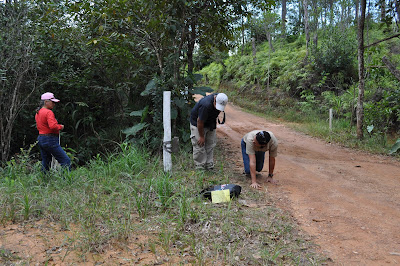
We decided not to place a camera trap at Tiger Falls as the GPS receiver reported that it was too close to a "trap" we already had on non-HVI land. We set off by vehicle instead towards the HVI airstrip and found a perfect site: a bridge over a steep-banked creek which will funnel wildlife through the trap:
From 2012-01-06
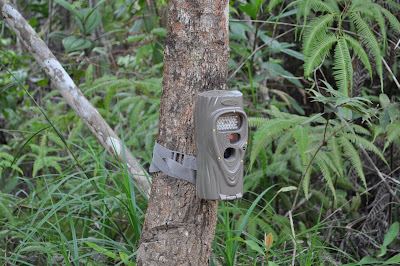
Don't tell the tapir (Tapirus bairdii), but this is what our camera traps look like:
From 2012-01-06
Having daylight left, and wanting a better sense of the landscape of HVI, we went to the King Vulture Falls:
From 2012-01-06
and of course spotted a King Vulture (Sarcoramphus papa), through a spotting scope:
From 2012-01-06
on this ridge (zoom in the see him! [kidding]):
From 2012-01-06
(Hint: he is roosting in a tree near the upper right LOL).
The broadleaf canopy below us was fascinating:
From 2012-01-06
as was the vegetation clinging to the cliffs:
From 2012-01-06
Good times!

Our work done, we returned to the main house for lunch. Erik had a fish sandwich and Rhea a Greek salad. Both good, but the Greek salad was exceptional. It burst with flavor from fresh ingredients. Our friend had a burger, and our HVI host the stewed chicken. We shared stories and generally had a delightful repast. While we dined, the HVI manager brought the owner over to our table to meet us. There is definitely something to be said for staying at an exclusive resort with twelve cottages!